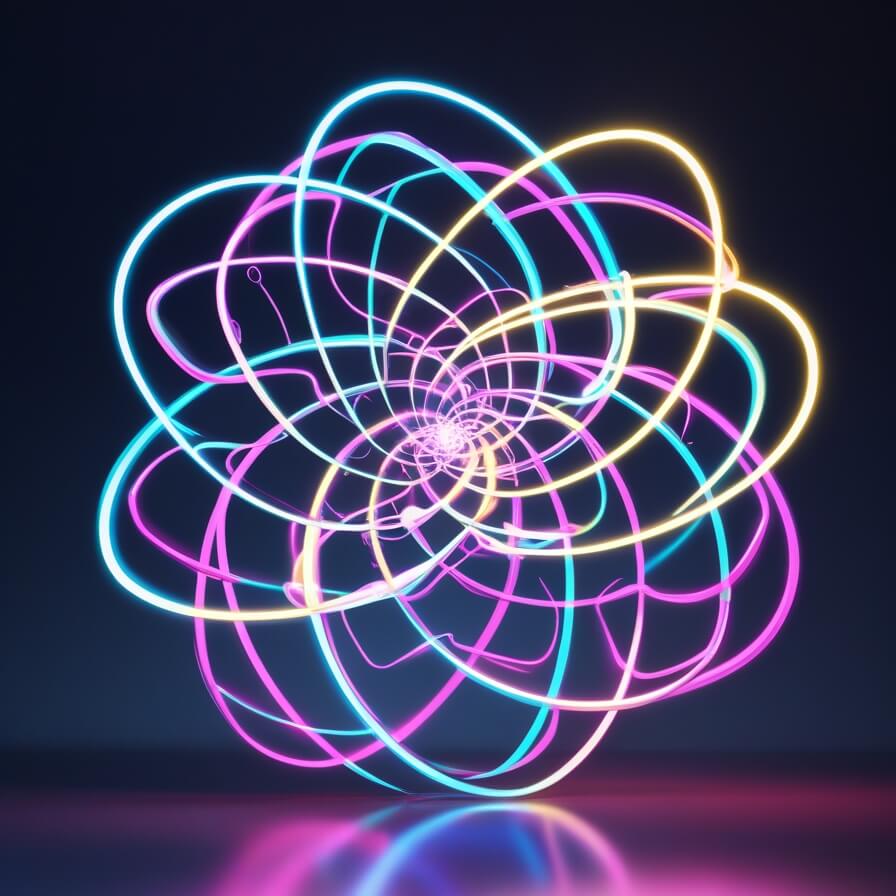
The Spirograph Drawer
Discover the mathematical beauty behind the Spirograph. This guide breaks down the core parametric equations, the role of $\boldsymbol{R}$, $\boldsymbol{r}$, and $\boldsymbol{P}$ in generating mesmerizing curves, and how the Frolix tool brings Hypocycloid geometry to life in the browser.
The Spirograph Drawer: Unlocking the Parametric Math Behind Perfect Curves
1. Introduction: The Intersection of Art and Geometry
The Spirograph, initially a simple plastic toy, is in fact a sophisticated demonstration of Parametric Geometry. It allows the creation of elegant and often mesmerizing curves through the controlled rotation of two circles. At Frolix, we've taken this classic concept and rebuilt it using pure web technology.
The Frolix Spirograph Drawer tool is a custom-engineered application that translates complex mathematical formulas—specifically Hypocycloid and Epicycloid curves—into real-time, interactive art. This deep dive will explore the physics and mathematics that power the drawer, providing a complete understanding of how simple variables generate structures of stunning complexity. This technical breakdown showcases the Expertise (E) that defines the Frolix platform.
2. The Mathematical Core: Hypocycloid and Epicycloid Curves
The curves generated by a Spirograph are defined by the path of a point (the pen) on a small rolling circle as it moves either inside or outside a larger fixed circle.
2.1. Defining the Variables
The shape of the final curve is dictated by three primary variables:
-
$R$ (Radius of the Fixed Circle): The size of the stationary gear.
-
$r$ (Radius of the Moving Circle): The size of the gear that rolls inside or outside $R$.
-
$P$ (Pen Distance): The distance of the drawing point (pen) from the center of the moving circle ($r$). $P$ is often represented as a fraction of $r$.
2.2. The Parametric Equations
These complex paths are defined by a system of parametric equations where the position of the pen $(x, y)$ is calculated based on a single variable, $\theta$ (theta), which represents the angle of rotation.
For the Hypocycloid (inner rolling motion), the key formulas are:
$$x(\theta) = (R-r)\cos(\theta) + P \cos\left(\frac{R-r}{r} \theta\right)$$
$$y(\theta) = (R-r)\sin(\theta) - P \sin\left(\frac{R-r}{r} \theta\right)$$
These equations govern every pixel drawn on the Frolix canvas. By manipulating $R$, $r$, and $P$, you are mathematically transforming the final shape, resulting in complex, beautiful patterns that are determined solely by number theory.
3. Translating Math to the Digital Canvas
Implementing these formulas in a browser environment requires careful coding to ensure smooth, high-fidelity curves without crashing the browser.
3.1. The JavaScript Iteration Loop
Our engine uses a JavaScript function that increments the angle $\theta$ by a tiny amount (e.g., $0.01$ radians) in a continuous loop. For each increment, the function:
-
Calculates the new $(x, y)$ coordinate using the current $R$, $r$, and $P$ values.
-
Draws a line segment connecting the previous point to the new point on the HTML5 Canvas.
This process repeats until the curve returns to its exact starting point, completing the perfect loop.
3.2. Achieving Curve Closure: The LCM Principle
A crucial mathematical detail is ensuring the curve closes perfectly. The number of 'petals' or cusps the Spirograph produces is determined by the Least Common Multiple (LCM) of $R$ and $r$.
-
The curve closes when the moving gear ($r$) has completed enough full rotations to bring the pen back to its starting coordinate.
-
Our engine calculates the required range of $\theta$ based on the ratio $R/r$ to ensure the drawing loop is efficient and stops precisely at the closure point, preventing unnecessary drawing time and performance lag.
4. Creative Control: Mastering the Ratios
For users, the real magic lies in understanding the relationship between the two radii: $R$ and $r$.
-
Integer Ratios (e.g., $R=30, r=10$): When $R$ is a perfect multiple of $r$, the curve will close quickly, resulting in a shape with $r$ number of petals. These are often clean and geometric.
-
Fractional Ratios (e.g., $R=30, r=13$): When the ratio is a fraction, the curve takes many more rotations to close. This is where the mesmerizing, complex, interwoven patterns emerge, as the pen fills in the gaps over hundreds of loops.
-
The Role of P: If $P < r$, the pen draws inside the moving gear, resulting in curves with sharp cusps. If $P > r$, the pen extends beyond the moving gear, creating loops and swells.
By allowing users to independently adjust $R$, $r$, and $P$, the Frolix tool enables the exploration of an infinite number of mathematically precise, unique designs.
5. Optimizing for the Browser (Performance and UX)
The challenge of Spirograph drawing is rendering thousands of points in real-time without flicker.
-
Canvas Context Management: To allow for smooth changes in color and thickness during a single draw, we utilize the Canvas's path creation methods efficiently, ensuring the entire curve is drawn in one smooth stroke.
-
Dynamic Resolution: For very complex, long-running fractional curves, our engine automatically adjusts the $\theta$ increment to ensure the draw speed remains visually acceptable, balancing mathematical accuracy with smooth User Experience (UX).
-
Color Cycling: The ability to dynamically cycle the color based on the current $\theta$ value is an artistic feature implemented by mapping the angle's progress to an HSL (Hue, Saturation, Lightness) color gradient, transforming a purely mathematical output into genuine generative art.
6. Conclusion: From Formula to Fractal
The Frolix Spirograph Drawer is a perfect embodiment of our site's philosophy: complex mathematics translated into accessible, engaging web experiences. The simplicity of the controls belies the power of the parametric equations working beneath the surface.
By understanding the relationship between $R$, $r$, and $P$, you are not just drawing a pretty picture—you are visualizing the elegance of differential geometry in action. This tool serves as a bridge between the precision of code and the endless possibility of art.