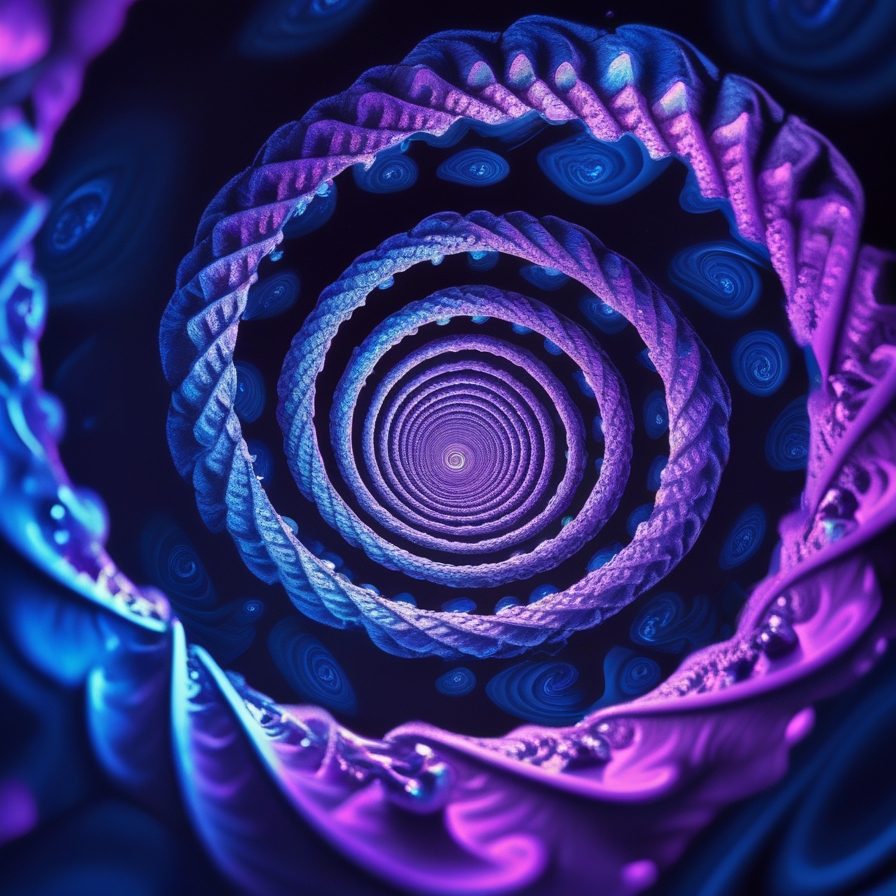
Endless Zoom Illusion
Discover the programming secrets behind the hypnotic Endless Zoom Illusion. This guide explains how fractal geometry and recursive canvas techniques create the mesmerizing infinity effect, showcasing the Frolix tool's technical precision.
Uncover the hypnotic secrets of the Endless Zoom Illusion
1. Introduction: The Hypnotic Power of Infinity
The concept of endless repetition and recursive structures has fascinated mathematicians and artists for centuries. The Endless Zoom Illusion (also known as the "Droste Effect" or a specific type of fractal zoom) is a perfect digital manifestation of this idea. It creates the mesmerizing visual experience of continuously zooming into an image, only to find the entire image repeated perfectly within the zoomed area, suggesting a journey toward infinity.
Our Frolix Endless Zoom Illusion tool is a custom-engineered example of this technical marvel. It's a testament to the power of modern web development in creating complex, real-time visual experiences. This comprehensive guide will establish the technical expertise of the Frolix team by breaking down the mathematics of recursion, the programming logic, and the Canvas optimization techniques required to keep the illusion seamless and fast.
2. The Core Principle: Recursion and Self-Similarity
The Endless Zoom Illusion is built entirely on the mathematical principle of recursion and the artistic concept of self-similarity.
-
Self-Similarity: This is the property where a part of an object is a miniature, exact replica of the whole. This is the defining characteristic of fractals, such as the Mandelbrot set or the Sierpiński gasket.
-
Recursion: In programming, recursion is the process where a function calls itself. To create the illusion, a core rendering function must call itself repeatedly, at smaller scales and slightly altered positions, each time drawing a miniature version of the original scene inside the previous one.
The illusion is achieved by mathematically placing the entire image—including the embedded mini-image—into the viewable area, and then continuously calculating the next smaller instance as the camera "moves in."
3. Programming Logic: The Infinite Loop on Canvas
The technical implementation is tricky, requiring precise calculations to maintain the illusion of seamless motion and scale.
3.1. The Setup: HTML5 Canvas
The simulation is rendered entirely on an HTML5 Canvas. This is crucial because continuously redrawing and manipulating thousands of DOM elements would be computationally impossible. The Canvas API allows us to manage the scene as pixel data, which is far more performant.
3.2. Defining the Transformation Matrix
The key to smooth zooming is the Transformation Matrix, which controls the scale, rotation, and translation (movement) of the image within the canvas's coordinate system.
The recursive function must calculate the parameters for the next frame based on the current zoom level:
-
Scaling: The scale must be reduced by a fixed factor (e.g., $90\%$ of the previous size) in each step of the recursion.
-
Translation: The image must be shifted precisely so that the point of interest (the 'center' of the illusion) remains stationary in the frame.
3.3. The Recursive Draw Call
The primary function, let's call it drawIllusion(), works as follows:
-
Draws the largest instance of the image.
-
Calculates the position, scale, and rotation for the next, smaller instance.
-
Calls
drawIllusion()again with the new, reduced parameters.
This function continues until the image's calculated size drops below a minimum renderable threshold (e.g., 5 pixels). This threshold is vital to prevent an actual infinite loop that would crash the browser.
4. Technical Challenge: Maintaining Seamless Motion
The biggest technical challenge is avoiding the "stutter" or "pop" when the recursive function resets or loops back.
4.1. The Reset Trigger
The illusion doesn't truly zoom forever; it only appears to. When the zoom level reaches a predetermined maximum (where the smallest embedded image fills the entire screen), the engine must instantly reset the zoom parameters and start the cycle over. This reset is hidden from the user by:
-
Timing: The reset happens precisely at the moment the viewer's eye is focused on the central, unchanging point of the illusion.
-
Speed: Due to the fast frame rate (60 FPS), the human eye perceives the brief reset as a continuous, smooth transition.
4.2. Performance Optimization
To maintain a high frame rate, the engine utilizes:
-
RequestAnimationFrame: This standard API ensures that the drawing cycle is synchronized with the browser's refresh rate, resulting in the smoothest possible animation.
-
Pre-rendering: The initial image or pattern is pre-rendered and cached, so the recursive function only needs to manipulate the transformation matrix for each frame, not redraw the entire content from scratch.
5. Advanced Applications: Beyond Simple Repetition
The math behind the zoom illusion is not just for novelty; it has practical and artistic applications:
-
Fractal Visualization: This same recursive logic is used to explore and generate complex, non-integer dimension fractals (like the Mandelbrot set).
-
Video Game Environments: Similar techniques are used to generate large, detailed, self-similar game worlds without consuming massive amounts of memory.
-
Generative Art: By introducing variables for rotation, color shifting, or displacement at each recursive level, the tool can create unpredictable, evolving artistic patterns.
6. Mastering the Frolix Illusion Controls (Expertise)
The Frolix tool gives you control over the parameters that define the illusion, allowing you to influence the rate of zoom, the color, and the base image. Experimenting with these variables is key:
-
Base Image Complexity: The choice of the initial image (simple geometric shapes, text, or complex patterns) drastically changes the final visual impact. Simple shapes are easier to track; complex patterns create a richer, more chaotic fractal effect.
-
Zoom Rate: A slower rate ($0.98$ scaling factor) is more relaxing, while a faster rate ($0.90$ scaling factor) is more aggressive and hypnotic.
-
Rotation: Introducing a slight rotation at each recursive step turns the straight zoom into a spiraling tunnel illusion, multiplying the complexity.
7. Conclusion: The Marriage of Code and Aesthetics
The Endless Zoom Illusion is a perfect marriage of computational power and visual aesthetics. It is a powerful example of how complex mathematics—specifically recursion and self-similarity—can be translated into an accessible, engaging web experience.
The Frolix team's development of this tool highlights our commitment to pushing the boundaries of web graphics and delivering unique, high-quality interactive content. We encourage you to spend some time experimenting with the zoom rate and base patterns. Observe the mathematical precision required to keep the illusion seamless.